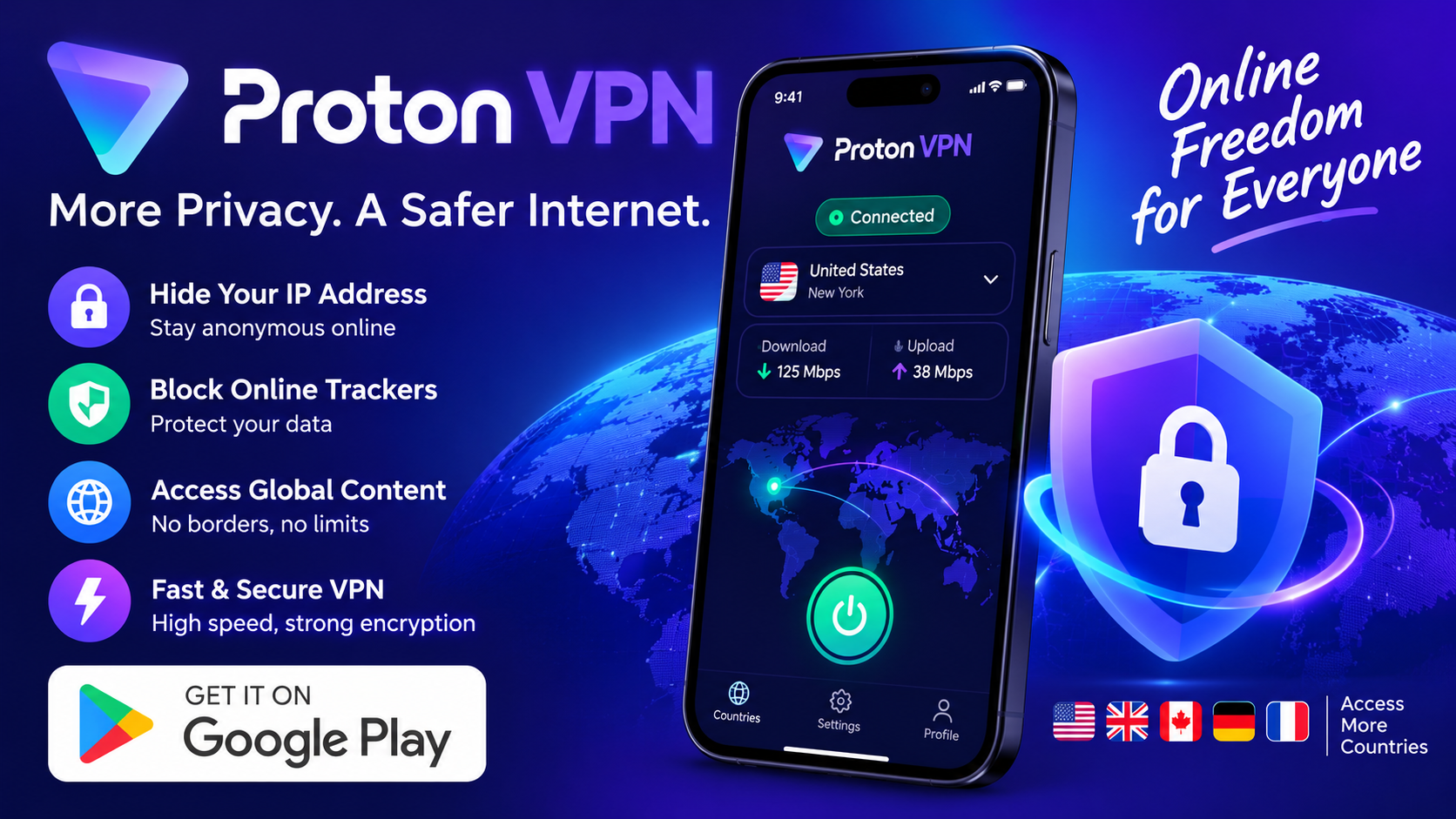
If you've ever searched for a VPN on the Google Play Store, you know the drill: hundreds of apps promising "military-grade encryption," "lightning-fast speeds," and "complete anonymity," most of which are ad-supported data harvesters in disguise. Proton VPN enters that arena with a genuinely different pitch—it's the only free VPN app that combines no bandwidth limits, a strict no-logs policy, and open-source transparency. The app is published by Proton AG, the Swiss company behind Proton Mail, and it's been independently audited and endorsed by outlets like Wired ("the best VPN you can buy") and Mashable ("the best VPN for most people"). For anyone who values privacy as a right rather than a luxury, that pedigree matters.
The free tier is unusually generous—and that's the headline
Most "free" VPNs throttle your speed after a few hundred megabytes or lock you into watching ads. Proton VPN's free plan does neither. You get unlimited bandwidth and speed, access to servers in 10 countries, strong encryption with DNS leak protection, and an automatic kill switch that prevents data exposure if the connection drops. You don't even need to create an account—one tap and you're connected. That's a remarkable proposition for casual users who just want a secure connection on public Wi-Fi at a coffee shop or airport. The trade-offs are real (more on that below), but as a baseline offering, it's hard to beat.
Premium unlocks the full arsenal—and the numbers are impressive
Upgrade to a paid plan and Proton VPN's scope expands dramatically:
- 20,000+ private servers across 140+ countries, with speeds up to 10 Gbps
- Up to 10 simultaneous device connections—covering Android, iOS, Windows, macOS, Linux, and browser extensions for Chrome, Firefox, Safari, Brave, and Opera
- NetShield ad and malware blocker, which also stops website trackers
- Secure Core (multi-hop VPN) for defense against network-based attacks
- Split tunneling, so you can choose which apps route through the VPN
- Dedicated P2P connections optimized for file sharing
For power users, journalists, or remote workers handling sensitive data, that's a compelling toolkit—especially at a price point Mashable calls "great value."
Security isn't just marketing here—it's verifiable
Proton VPN uses AES-256 encryption paired with 4096-bit RSA, the same standards trusted by governments and financial institutions. But what really distinguishes it is transparency: the code is fully open source, meaning anyone can inspect it, and the service has undergone independent security audits. The company's no-logs policy means it doesn't track or store your browsing activity. Data in transit is encrypted, and the developer declares that no data is shared with third parties. In a category riddled with vague promises and opaque ownership, that level of verifiability is refreshing—and arguably the strongest argument for choosing Proton over a cheaper alternative.
Real users love the concept—but speed and reliability complaints are common
The Play Store reviews tell a more nuanced story. With 1.3 million ratings, the app has a substantial user base, and the feedback splits along predictable lines. One reviewer praised the fast connections and free access but noted that Twitter and Instagram loaded slowly, with U.S. and Netherlands servers performing best. A paying monthly subscriber was far less impressed, reporting average update speeds of only 300–400 KB/s, 480p livestreams that stuttered constantly, and many listed servers that turned out to be unusable despite showing low congestion. Another long-term premium user described login times of 5–30 minutes on desktop, browser extensions that frequently failed, and mobile connections that could take anywhere from 10 seconds to 3 minutes—while still praising the UI, privacy features, and protocol options.
Context matters: geography and expectations shape the experience
It's worth reading those complaints with context. Proton's support team consistently responds that the company doesn't limit bandwidth—your speed depends on server distance, server load, and your own ISP. For users in heavily restricted regions like mainland China, the challenges are even more acute: Proton acknowledges that VPN connections are aggressively blocked there and recommends its Stealth protocol as a workaround. Meanwhile, users in regions with fewer restrictions often report smooth experiences. The lesson? Proton VPN is a privacy tool first and a streaming/unblocking tool second. If your priority is bypassing geo-restrictions at high speed, your mileage may vary; if it's securing your connection without surrendering your data, it delivers.
The verdict: a trustworthy VPN with realistic caveats
Proton VPN isn't perfect. Free users get a limited server selection, premium speeds can disappoint depending on your location, and users behind aggressive firewalls may find connections frustrating. But the fundamentals—genuine no-logs architecture, open-source code, independent audits, unlimited free bandwidth, and a Swiss privacy jurisdiction—are exactly what a VPN should be built on. Our advice: start with the free tier, test server speeds in your region, and only upgrade if the premium features like NetShield, Secure Core, and split tunneling genuinely fit your workflow. In a market full of apps that monetize your data, Proton VPN remains one of the few that treats your privacy as the product's purpose rather than its cost—and that alone makes it worth a download.